Neck Pain Driving: 10 Common Causes And Easy Fixes For A More Comfortable Ride
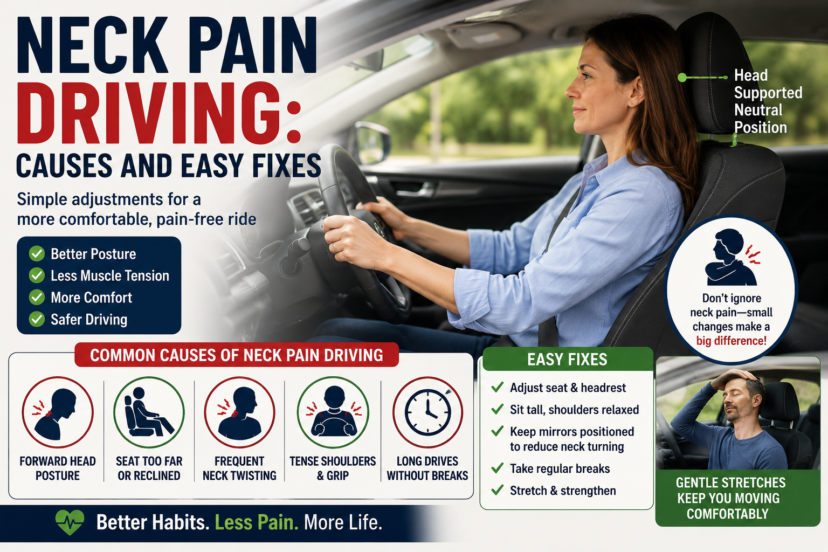
If your neck feels fine when you leave home but stiff, tight, or sore by the time you arrive, your driving position may be part of the problem. Neck pain driving is especially frustrating because you can’t simply stretch, change chairs, or walk around whenever discomfort starts. Commuting, road trips, traffic, and hours behind the wheel can keep your neck and shoulders in nearly the same position for long periods.
Fortunately, you may not need a new vehicle or expensive ergonomic equipment to feel better. Small changes to your seat, head restraint, steering wheel, mirrors, and driving habits can reduce unnecessary strain.
Regular movement outside the car also matters. By combining better driving ergonomics with gentle mobility, strengthening, and sensible breaks, you can make driving more comfortable while supporting neck health, mobility, and independence as you age.
🚗 Quick Answer: Neck Pain Driving
Neck pain while driving often develops because of prolonged sitting, forward-head posture, poor seat positioning, tense shoulders, or repeatedly turning the neck to check traffic. Adjust your seat so your back and head are comfortably supported, move closer to the steering wheel if you’re reaching, relax your shoulders, position your mirrors correctly, and take movement breaks during longer trips. Regular mobility and strengthening exercises may also help prevent recurring stiffness.
Key Takeaways
Most likely cause: Prolonged sitting combined with poor driving ergonomics, forward-head posture, shoulder tension, or limited movement.
Usually serious? Usually not. Driving-related stiffness is often muscular or related to prolonged positioning, but persistent, severe, or neurological symptoms require medical evaluation.
First thing to check: Your seat distance, backrest angle, head restraint, steering wheel position, and whether you’re reaching forward while driving.
Best solution: Reduce neck pain while driving by improving your driving position, relaxing unnecessary muscle tension, taking regular movement breaks, and building neck and upper-back strength.
🧠 Why Driving Can Trigger Neck Pain
Driving may not seem physically demanding, but your muscles remain active throughout the trip.
Your neck helps stabilize your head while your eyes scan the road. Your shoulders and arms control the steering wheel, while your upper back supports your posture.
Unlike walking, you have relatively few opportunities to change position.
Traffic can make things worse. You may unconsciously grip the wheel harder, raise your shoulders, clench your jaw, or lean toward the windshield.
Road vibration can also add to fatigue during longer journeys.
The problem is usually not one particular posture. It’s maintaining the same position for too long.
That’s why reducing neck pain driving often requires two strategies: improving your position and increasing movement whenever it is safe to do so.
🪑 1. Your Seat Is Too Far From The Steering Wheel
A common driving mistake is positioning the seat too far back.
You may then reach forward with your arms while your shoulders and head move away from the seat.
That can increase fatigue through the shoulders, upper back, and neck.
Move the seat forward enough that you can comfortably operate the pedals while maintaining a slight bend in your elbows when holding the steering wheel.
Your shoulders should remain comfortably supported by the seat rather than constantly reaching forward.
Never position yourself so close that you compromise safe clearance from the steering wheel and airbag. Follow your vehicle manufacturer’s recommendations for proper seating and airbag safety.
🚘 2. Your Backrest Is Reclined Too Far
Some drivers lean their seat far backward because it initially feels relaxing.
The problem is that you may then bring your head and shoulders forward to see the road clearly.
This creates a mismatch: your torso is reclined while your neck moves forward.
Adjust the seatback so it comfortably supports your upper body without forcing you to reach toward the steering wheel.
You don’t need to sit perfectly vertical.
The goal is a supported position where you can see the road, reach the controls, and steer without leaning forward.
This simple adjustment can sometimes make an immediate difference in neck pain while driving.
🧍 3. Your Head Stays Forward The Entire Trip
Forward-head posture can develop gradually.
You may start with your head against or near the head restraint but slowly drift toward the windshield.
This is especially common when concentrating on traffic or struggling to see signs clearly.
Periodically check your position when safely stopped.
Ask yourself:
Am I sitting back, or am I reaching toward the road with my head?
If you repeatedly lean forward because road signs are difficult to see, consider having your vision checked.
Don’t simply force your head backward. Instead, improve your entire sitting position so your head can remain comfortably balanced over your torso.
🛡️ 4. Your Head Restraint Is Poorly Adjusted
Your vehicle’s head restraint is primarily a safety feature designed to help reduce head and neck movement during a collision.
Its position can also affect how your driving posture feels.
If it’s positioned poorly, you may feel as though your head is being pushed forward—or you may sit too far away from it.
Check your vehicle owner’s manual for the correct adjustment.
In general, the head restraint should be appropriately positioned behind your head rather than down near your neck.
Avoid removing or modifying safety equipment simply to make the seat feel more comfortable.
If you’re struggling to find a comfortable position, adjusting the seatback and seat height may solve the problem without altering the restraint.
💪 5. You’re Holding The Steering Wheel Too Tightly
Have you ever arrived home after stressful traffic and realized your shoulders were almost touching your ears?
Stress-related muscle tension can contribute to neck pain driving.
You may grip the steering wheel tightly, lock your elbows, tense your shoulders, and clench your jaw without noticing.
When road conditions allow, periodically check your grip.
You need secure control of the vehicle, but you don’t need to squeeze the steering wheel continuously.
Relax your shoulders away from your ears and allow a comfortable bend in your elbows.
Slow breathing may also help reduce unnecessary tension during traffic.
🪞 6. Your Mirrors Encourage Repeated Neck Turning
Correct mirror positioning improves safety and may also reduce unnecessary head movement.
If your mirrors are poorly positioned, you may repeatedly twist or lean to check surrounding traffic.
Set your mirrors before you begin driving.
Your side and rearview mirrors should provide the best practical field of view while you’re sitting in your normal driving position.
However, mirrors do not eliminate blind spots.
Always follow safe driving practices and turn your head when necessary to check areas that aren’t visible in the mirrors or your vehicle’s safety systems.
The goal isn’t to stop moving your neck. It’s to avoid unnecessary reaching, leaning, and excessive rotation caused by poor setup.
👀 7. Limited Neck Mobility Makes Traffic Checks Harder
Turning your head to check traffic may become more difficult as your neck becomes stiff.
This can be particularly noticeable for older adults or people with arthritis and other musculoskeletal conditions.
Don’t try to force your neck farther while driving.
Instead, work on comfortable mobility outside the vehicle.
Gentle range-of-motion exercises may gradually improve your ability to turn your head.
If restricted movement makes it difficult to check blind spots safely, speak with a physician, physical therapist, or occupational therapist.
Safe driving ability is more important than pushing through pain.
⏰ 8. You’re Driving Too Long Without A Break
Even an excellent seat position can become uncomfortable after several hours.
Long road trips are therefore a common trigger for neck pain driving.
When practical, build regular breaks into longer journeys.
For example, stopping every hour or two gives you an opportunity to:
- Get out of the vehicle.
- Walk for several minutes.
- Move your shoulders.
- Gently turn your neck.
- Change your overall posture.
- Hydrate.
Your individual needs may vary, and you should stop sooner if fatigue or discomfort affects your ability to drive safely.
A five-minute break can feel surprisingly good after a long stretch of highway.
📱 9. Your Neck Is Already Tired Before You Start Driving
Sometimes the car isn’t the original problem.
Imagine spending eight hours at a computer, followed by an hour looking down at your phone.
Then you get into the car for a 45-minute commute.
Your neck may already be fatigued before the engine starts.
Look at your entire day.
Improving workstation ergonomics, reducing prolonged phone positions, exercising regularly, and taking movement breaks during work may improve how you feel while driving.
This whole-day approach is often more useful than trying to find one “perfect” car posture.
👛 10. You’re Sitting Unevenly
What you sit on can change your posture.
A thick wallet in a back pocket is a classic example. It may raise one side of the pelvis, particularly during long drives.
Bulky items in pockets can also become uncomfortable and encourage you to shift your weight.
Remove large objects from your back pockets before longer drives.
Also check whether the seat itself encourages you to lean toward one side.
A relatively balanced sitting position can reduce unnecessary compensation through the lower back, shoulders, and neck.
🤸 Gentle Exercises For Neck Pain After Driving
If you step out of the car feeling stiff, you don’t need an aggressive stretching routine.
Gentle movement is a good place to start.
Gentle Neck Turns
Slowly turn your head to one side within a comfortable range.
Return to center and repeat on the opposite side.
Avoid forcing the movement.
Shoulder Rolls
Roll your shoulders backward several times, then relax them.
This is particularly useful if you tend to tense your shoulders while driving.
Shoulder Blade Squeezes
Gently draw your shoulder blades toward each other.
Hold briefly, then relax.
Keep the movement comfortable rather than aggressively squeezing.
Take A Short Walk
Walking may be one of the simplest natural ways to loosen your body after a long drive.
Even five minutes can help you transition from prolonged sitting back into normal movement.
Stop any exercise that causes significant pain, dizziness, numbness, weakness, or symptoms traveling down an arm.
🌿 Home Remedies For Neck Pain After Driving
Mild muscular discomfort often responds to simple measures.
Try Gentle Heat
A warm shower or heating pad may temporarily relax tight neck and shoulder muscles.
Use a comfortable temperature, protect your skin, and don’t fall asleep on a heating pad.
Keep Moving
Avoid spending the rest of your day completely inactive just because your neck feels stiff.
Gentle everyday movement may be more helpful than staying rigidly still.
Prioritize Sleep
A long commute followed by poor sleep can make discomfort harder to manage.
Use a pillow that keeps your neck in a comfortable position and aim for a consistent sleep schedule.
Manage Stress
Traffic can be mentally and physically exhausting.
Relaxation techniques, regular exercise, enjoyable hobbies, and good sleep habits can help reduce the overall stress load that contributes to muscle tension.
🏋️ Strengthening Can Support Long-Term Neck Comfort
If neck pain driving keeps returning, stretching alone may not be enough.
Your neck depends on surrounding muscles for support and endurance.
A balanced strengthening program may target the shoulders, upper back, shoulder blades, and deep neck muscles.
Depending on your health and abilities, exercises may include:
- Resistance-band rows.
- Controlled shoulder-blade exercises.
- Gentle chin-tuck variations.
- Light resistance training.
- Upper-back strengthening.
- Whole-body strength exercises.
Don’t assume that every neck exercise you find online is appropriate for your condition.
If pain is persistent, a physical therapist can create a program based on your symptoms, strength, range of motion, and goals.
🧑 How Physical Therapy May Help Drivers
Physical therapy can be particularly useful when driving is one of several activities causing recurring symptoms.
A physical therapist may assess your neck movement, upper-body strength, posture, muscle endurance, and driving setup.
Treatment might include:
- Mobility exercises.
- Progressive strengthening.
- Postural training.
- Ergonomic recommendations.
- Manual therapy when appropriate.
- Strategies for returning to normal activities.
An occupational therapist may also be helpful when pain, arthritis, limited mobility, or age-related changes make driving activities difficult.
The objective isn’t simply to reduce pain temporarily.
It’s to help you maintain safe, comfortable mobility and independence.
⚕️ When To See A Doctor About Neck Pain While Driving
Occasional mild stiffness after a long drive isn’t unusual.
But persistent or severe symptoms shouldn’t automatically be blamed on your car seat.
Schedule a medical evaluation if your neck pain continues for several weeks, progressively worsens, repeatedly interrupts sleep, or significantly limits normal activities.
Seek prompt medical attention for symptoms such as:
- New or worsening arm or hand weakness.
- Significant numbness or tingling.
- Problems with walking or balance.
- Loss of coordination.
- Severe headache with fever or pronounced neck stiffness.
- Pain following a significant vehicle collision, fall, or injury.
- Loss of bladder or bowel control.
- Unexplained weight loss or other concerning systemic symptoms.
After a car accident, neck symptoms may not always appear immediately. Seek appropriate medical evaluation when symptoms develop following a collision.
Call 911 in the U.S. for possible emergency symptoms such as chest pressure, shortness of breath, sweating, nausea, or pain spreading into the jaw, neck, shoulder, or arm.
❓ FAQs About Neck Pain Driving
Why Does My Neck Hurt Every Time I Drive?
Neck pain driving may result from prolonged sitting, reaching toward the steering wheel, forward-head posture, shoulder tension, limited mobility, or an uncomfortable seat setup. Your work and phone habits before driving may also contribute.
How Should I Sit In A Car To Prevent Neck Pain?
Sit with your back comfortably supported, your shoulders relaxed, and your seat close enough that you can steer without reaching. Adjust your head restraint, mirrors, seat height, and steering wheel according to your vehicle’s instructions and safe-driving requirements.
Can A Car Head Restraint Cause Neck Pain?
A poorly positioned head restraint or incompatible seat geometry may feel uncomfortable for some people. However, the head restraint is an important safety feature. Don’t remove it. Adjust the seat and restraint according to the vehicle manufacturer’s instructions.
How Do I Relax My Neck While Driving?
When conditions allow, relax unnecessary shoulder tension and avoid gripping the steering wheel harder than necessary. During longer trips, stop somewhere safe, get out of the car, walk, and gently move your neck and shoulders.
Why Does My Neck Hurt More After A Long Road Trip?
Long road trips require prolonged sitting with limited position changes. Muscles can become fatigued and stiff, especially if you’re reaching, leaning forward, or holding tension through your shoulders.
What Exercises Help Neck Pain From Driving?
Gentle neck rotations, shoulder rolls, walking, and appropriate upper-back and shoulder strengthening may help. Persistent symptoms may benefit from an individualized physical therapy program.
Can Driving Make A Pinched Nerve In The Neck Worse?
Prolonged positions may aggravate symptoms in some people with cervical nerve irritation. Pain, tingling, numbness, or weakness traveling into the arm or hand should be discussed with a healthcare professional, particularly if symptoms are new or worsening.
🌟 Final Thoughts On Neck Pain Driving
Driving shouldn’t leave you feeling as though you’ve completed a workout with your neck.
If your discomfort repeatedly appears behind the wheel, start with the simplest fixes before spending money on special cushions or accessories.
Move your seat closer if you’re reaching. Support your back. Relax your shoulders. Adjust your mirrors. Take breaks on long trips. And pay attention to the hours you spend sitting before you ever enter the car.
Reducing neck pain while driving usually isn’t about discovering one magical posture. It’s about creating a comfortable setup, moving regularly, and gradually improving the strength and mobility that support everyday activities.
Give these changes time.
A few small adjustments repeated every day can help make commuting, errands, vacations, and road trips more comfortable—allowing you to stay mobile, independent, and active for years to come.
Medical Disclaimer: This article is provided for general educational and informational purposes only. It is not intended to diagnose, treat, cure, or prevent any medical condition and should not replace personalized medical advice. Consult a physician, physical therapist, or other qualified healthcare professional for persistent, severe, worsening, or unexplained neck pain or before beginning a new exercise program.
 Explore more:
- Reading In Bed Neck Pain: Why This Relaxing
- Neck Pain And Dizziness: Is There A Connection?
- Common Neck Pain Mistakes: 11 Everyday Habits